Grocery prices in 2026 are hitting families harder than ever. The average American household now spends over $1,000 per month on food.
Most people don’t realize how much they’re overspending on items they could get for less or don’t actually need. Your grocery budget is one of the easiest places to find extra money each month without feeling deprived.

The good news: you can cut grocery bill in half — and this guide shows you exactly how. These aren’t extreme couponing tactics that take hours of your time.
They’re practical changes that fit into your busy life and work even when money is tight. This guide gives you 15 actionable tips that can save you hundreds of dollars every month.
Even better, those savings can go straight toward paying off debt faster. When you redirect just $200 per month from groceries to your credit card balance, you can shave years off your repayment timeline and save thousands in interest.
How Grocery Savings Accelerate Debt Payoff
When you save $200 per month on groceries and put that money toward debt, the impact is bigger than you might think. Let’s look at what happens when you apply those savings to an $8,000 credit card balance at 20% APR.
| Payment Strategy | Monthly Payment | Time to Payoff | Total Interest Paid |
|---|---|---|---|
| Minimum only ($160) | $160 | 9 years, 8 months | $10,615 |
| Minimum + grocery savings | $360 | 2 years, 2 months | $1,789 |
By redirecting your grocery savings, you save $8,826 in interest and become debt-free over 7 years sooner. Use an Extra Payment Debt Payoff Calculator to see your own timeline improvement.
Transparency Notice: BreakFreeFromDebtNow is reader-supported. If you click on a link and make a purchase or sign up for a service, I may receive a small commission at no extra cost to you. This helps keep the site running and the content free for everyone. I only recommend products and services I truly believe can help you on your journey.
Important Disclaimer: I am not a financial advisor. I am a researcher and consumer advocate sharing what I've learned on my own debt-free journey. The information on this site is for educational and informational purposes only and does not constitute professional financial advice. Always consult with a certified financial professional for guidance specific to your unique situation. Full Disclaimer →
Key Takeaways
- Planning meals and shopping strategically can cut your grocery spending by 50% without sacrificing nutrition or quality
- Redirecting $200 in monthly grocery savings to an $8,000 credit card debt can reduce payoff time from nearly 10 years to just over 2 years
- Simple changes like buying in bulk, using cashback apps, and reducing food waste create immediate savings you can apply to financial goals
How Much Could You Really Save? (Real Numbers)
When you cut your grocery bill in half, you’re looking at real money that stays in your pocket each month. A Los Angeles family of four dropped their spending from $800-$1,000 down to just $400 monthly by using simple shopping strategies.
That’s $400 to $600 back in your budget every single month. Over a year, those grocery savings add up to $4,800 to $7,200.
Where Your Money Goes Next
Here’s something most people don’t think about: you can redirect those grocery savings straight to debt payoff. Let’s say you cut grocery costs by $200 each month and put that money toward an $8,000 credit card balance at 20% APR.
| Payment Method | Monthly Payment | Time to Pay Off | Total Interest Paid |
|---|---|---|---|
| Minimum only ($160) | $160 | 94 months | $7,040 |
| Minimum + grocery savings ($360) | $360 | 28 months | $1,680 |
You save $5,360 in interest and finish 66 months faster just by redirecting what you save on food.
Your Budget, Your Rules
Your savings might look different based on where you start. If you’re spending $600 monthly and cut your grocery bill to $300, that’s $3,600 yearly.
Even saving $100 per month gives you $1,200 to work with. Ready to see how fast you can crush your debt with extra payments?
Use the Extra Payment Debt Payoff Calculator to plug in your own numbers and watch your freedom date move closer.
Plan Before You Shop
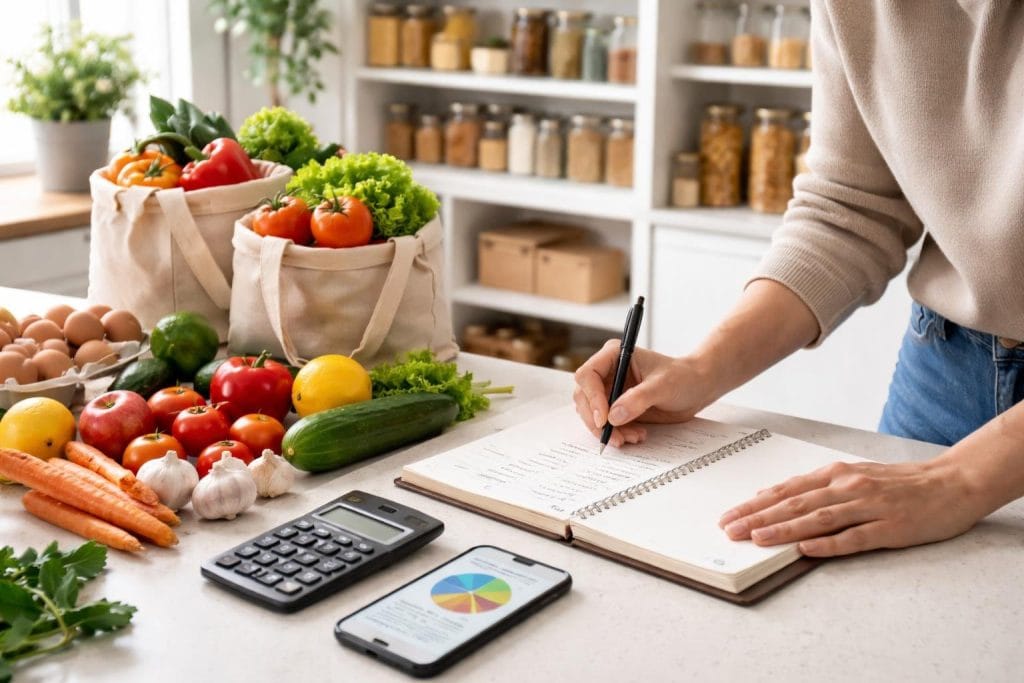
Walking into a grocery store without a plan is like shopping with your wallet wide open. Setting aside 15-20 minutes to plan your meals, create a focused list, and check what you already have can cut your grocery spending by 25-30% immediately.
Meal Planning
Start by choosing 5-7 dinners for the week. You don’t need elaborate recipes or Pinterest-worthy meals.
Write down simple options your household actually eats, like tacos, pasta with marinara, stir-fry, or rotisserie chicken with vegetables. Check your local store flyers before you plan your meals.
If chicken thighs are $2 per pound instead of the usual $4, build two or three meals around chicken that week. When ground beef goes on sale, plan for tacos, spaghetti sauce, and burgers.
Meal prep saves money by reducing takeout temptation. Chop vegetables on Sunday, cook rice in bulk, or marinate meat ahead of time.
When dinner is half-done, you’re less likely to order a $40 pizza because you’re tired. Create a master rotation of 20-30 meals your family enjoys.
Keep this list on your phone or stuck to your fridge. When you stop reinventing dinner every week, grocery shopping becomes faster and cheaper because you know exactly what ingredients you need.
Lists
A detailed shopping list is your defense against impulse purchases and forgotten items that force extra store trips. Write down everything you need, organized by store section: produce, meat, dairy, pantry items.
Stick to your list religiously. The only exception should be spotting an incredible deal on something you regularly use and can store.
That’s it. No “oh, these cookies look good” or “we might need this someday.”
Shop after eating a meal or substantial snack. Shopping hungry increases impulse purchases by 64% according to research.
Your brain wants quick energy, so you grab expensive snacks and convenience foods you didn’t plan to buy. Bring cash or load a prepaid card with your exact budget.
When the money runs out, you’re done shopping. This creates a hard limit that credit cards don’t provide.
Inventory
Check your fridge, freezer, and pantry before making your list. You probably have more food than you think.
Look for items that need to be used soon and plan meals around what’s on sale and what you already own. Keep a running inventory on your fridge with a notepad or phone app.
When you finish the last of something or notice you’re running low, add it immediately. This prevents the “I forgot we needed milk” trips where you walk out with $30 of unplanned items.
Check expiration dates during your inventory. Move older items to the front so you use them first.
That half-used jar of pasta sauce or wilting vegetables should drive tomorrow’s dinner plans, not get tossed in the trash.
Shop Smarter, Not Harder

Small changes in how you pick products can save you hundreds each month. Switching to store brands, using loyalty apps, and comparing unit prices takes minutes but keeps more money in your wallet.
Store Brands
Store brands cost 30-40% less than name brands, and they often come from the same factories. Your box of generic cereal might be identical to the name brand sitting next to it, just without the fancy packaging.
Start with basic items like flour, sugar, salt, and canned goods. These products are hard to mess up, and you won’t notice a difference in taste or quality.
Once you’re comfortable, branch out to other items like pasta, rice, frozen vegetables, and dairy products. Some store brands even beat their name-brand competitors in taste tests.
Try one item per shopping trip to find your favorites without overwhelming your routine. If something doesn’t work for you, switch back—but most shoppers find they prefer keeping the extra cash.
Generic brands work especially well for baking supplies, spices, and pantry staples where the ingredient list matters more than the label.
Loyalty Apps
Most grocery stores offer free loyalty programs that give you access to digital coupons and exclusive sales.
Download your store’s app and link it to your phone number or loyalty card.
Check the app before you shop to see what’s on sale that week.
Many apps let you clip digital coupons directly to your account, so discounts apply automatically at checkout.
You don’t need to print anything or carry stacks of paper.
Stack these savings with cashback apps like Ibotta or Rakuten.
Upload your receipt after shopping to earn money back on items you already bought.
Some stores also offer points programs where you earn rewards toward future purchases or gas discounts.
Set aside five minutes before each shopping trip to scan for deals.
Those few minutes can save you $20-30 per trip without changing what you buy.
Unit Prices
The biggest package isn’t always the best deal.
Check the unit price—the cost per ounce, pound, or count—on the shelf tag below each product.
A 16-ounce jar at $4.00 costs $0.25 per ounce.
A 24-ounce jar at $5.00 costs $0.21 per ounce, making it the better buy even though it costs more upfront.
Sometimes the smaller size is actually cheaper per unit, especially during sales.
Use unit prices to compare different brands too.
That fancy organic brand might be only a few cents more per ounce than the regular version, making it worth the upgrade.
Or you might find the price difference is huge, helping you decide if it’s worth the extra cost.
This trick works great for items you buy regularly like coffee, toilet paper, and cooking oil.
Over a year, choosing the better unit price on just five items can save you over $100.
Buy In Bulk And Freeze Strategically
Buying in bulk saves serious money when you focus on the right items.
Stock up on pantry staples like rice, pasta, oats, and canned goods that won’t spoil.
For fresh items, your freezer becomes your best friend.
Buying in bulk works best when you have a plan to preserve what you purchase.
Meat, bread, and frozen vegetables are perfect for bulk buying.
Purchase family packs of chicken, ground beef, or pork when they’re on sale.
Divide them into meal-sized portions and freeze immediately.
Best Items to Buy in Bulk and Freeze:
- Ground beef and turkey
- Chicken breasts and thighs
- Shredded cheese
- Butter
- Bread and bagels
- Berries and chopped vegetables
Label everything with the date and contents using a permanent marker.
This prevents freezer burn mysteries three months later.
Reduce Food Waste (The Hidden Budget Leak)
Food waste drains your budget faster than you realize.
The average family throws away about $1,500 worth of food each year.
Start by using what you already have in your fridge or pantry before buying more groceries.
Try a pantry challenge where you build meals from ingredients you already own.
You might discover forgotten cans of beans or half-empty boxes of pasta that become dinner.
Meatless meals help stretch your budget and reduce waste.
Beans, lentils, and eggs cost less per serving than meat and last longer in your pantry.
Even cutting meat from just two dinners per week saves money.
Grow your own herbs on a windowsill or small pot.
Fresh herbs go bad quickly when bought from stores, but a basil or parsley plant keeps producing for months.
You use only what you need each time.
Store food properly to make it last.
Keep bananas away from other fruit, wrap lettuce in paper towels, and freeze bread you won’t use within three days.
Turn leftovers into new meals instead of tossing them.
Roasted vegetables become soup.
Extra rice turns into fried rice.
Stale bread makes croutons.
Digital Tools And Apps That Cut Your Bill Instantly
Your phone holds the key to serious grocery savings.
Apps like Ibotta and Fetch Rewards put money back in your pocket with minimal effort.
Ibotta pays you cash back after you scan your receipt and product barcodes.
You can earn anywhere from $0.25 to several dollars per item, and many users save $20-$50 monthly.
Once you hit $20, cash out through PayPal or gift cards.
Fetch Rewards takes an even simpler approach.
Just scan any grocery receipt and earn points toward gift cards.
No need to clip coupons or activate offers beforehand.
For digital coupons, apps like Coupons.com work with store loyalty programs to automatically apply savings at checkout.
You clip the coupons in the app before shopping, and the discounts apply when you use your loyalty card.
The real magic happens when you stack these tools.
Use coupons from your store app, earn cash back through Ibotta, and scan your receipt in Fetch Rewards.
This triple-dip approach turns regular purchases into serious savings.
How To Redirect Your Grocery Savings Toward Debt Payoff
Once you start cutting your grocery bill, you’ll have extra cash each month. Instead of letting that money disappear into your regular spending, you can put it straight toward paying off debt.
Let’s say you save $200 per month on groceries using the strategies we covered. If you have an $8,000 credit card balance at 20% APR, that extra $200 can make a huge difference.
Here’s what happens when you redirect your grocery savings:
| Payment Strategy | Monthly Payment | Time to Pay Off | Total Interest Paid |
|---|---|---|---|
| Minimum payments only | $160 | 9 years, 2 months | $9,472 |
| Minimum + $200 grocery savings | $360 | 2 years, 2 months | $1,156 |
You’ll save over $8,000 in interest and knock out your debt seven years faster.
The trick is to make saving and debt payments automatic so you don’t accidentally spend that grocery money elsewhere.
Set up your bank account to transfer the savings directly to your credit card the same day you get paid.
Creating a budget helps you track where your grocery savings actually go each month.
Write down how much you used to spend and how much you spend now. The difference is what goes to debt.
Want to see exactly how extra payments will affect your specific debt situation? Use an Extra Payment Debt Payoff Calculator to plug in your numbers and watch how fast you can become debt-free.
Real Example: How Cutting $200/Month In Groceries Changed One Family’s Debt Timeline
A family of four in Los Angeles cut their monthly grocery spending from $800 to $400. They took that extra $200 and put it straight toward their credit card debt.
Let’s say you have $8,000 in credit card debt at 20% APR. Here’s what happens when you redirect grocery savings to debt payoff:
| Payment Strategy | Monthly Payment | Time to Pay Off | Total Interest Paid |
|---|---|---|---|
| Minimum only ($160) | $160 | 9 years, 3 months | $9,850 |
| Minimum + $200 grocery savings | $360 | 2 years, 2 months | $1,680 |
The math is simple. Every dollar you save on groceries can work for you instead of against you.
One person who reduced spending from $600 to $200 monthly for a household of two freed up $400 each month for other financial goals.
Small changes in your grocery routine add up fast when you redirect those savings.
Try the Extra Payment Debt Payoff Calculator to plug in your own numbers and create your personalized payoff plan.
Final Thoughts: Small Grocery Changes = Big Debt Freedom Impact
Cutting your grocery bill isn’t just about having more money in your checking account. It’s about creating real momentum toward getting out of debt.
Let’s say you implement a few simple tweaks and save $200 each month on groceries.
If you take that $200 and throw it at an $8,000 credit card balance charging 20% APR, you’ll see dramatic results.
| Payment Strategy | Monthly Payment | Time to Pay Off | Total Interest Paid |
|---|---|---|---|
| Minimum only ($160) | $160 | 9 years, 2 months | $9,523 |
| Minimum + $200 grocery savings | $360 | 2 years, 2 months | $1,247 |
You’d cut over seven years off your debt timeline and save more than $8,000 in interest.
The beauty of grocery savings is that they happen every single week.
Small changes in shopping habits add up faster than you think.
You’re not sacrificing quality or taste—you’re just being smarter about where your money goes.
Every dollar you redirect from your grocery budget to debt payoff works for you instead of against you.
Start with one or two changes this week. Track your spending for two weeks, make a meal plan, or switch to store brands on five items.
Want to see exactly how extra payments will impact your specific debt? Use an Extra Payment Debt Payoff Calculator to plug in your numbers and watch your payoff date move closer.
Frequently Asked Questions
Cutting your grocery spending involves smart planning, knowing where to find the best deals, and using the right tools to track your progress.
These answers address common concerns about eating well on less, finding practical shopping strategies, and making your budget work harder for you.
What are some effective strategies for eating healthy while slashing my grocery expenses?
Focus on whole foods instead of processed items or specialty organic products.
Beans, lentils, rice, oats, and seasonal produce give you the most nutrition for your money.
Frozen vegetables cost less than fresh and last longer in your freezer. They’re picked at peak ripeness and flash-frozen, so you’re not losing nutrients.
Buy whatever protein is on sale that week and plan your meals around it.
If chicken thighs are $2 off per pound, make three different chicken meals that week.
Shop the perimeter of the store first where fresh produce, meat, and dairy live.
Fill your cart with these basics before heading into the center aisles where processed foods cost more.
Planning meals around sale items helps you eat well without overspending.
Check store flyers before you write your shopping list.
Can I get a practical grocery list that keeps me under $150 a month?
A $150 monthly budget works out to about $35 per week for one person.
Here’s what that looks like in real shopping terms.
Proteins ($10):
- 2 pounds ground beef or turkey on sale
- 1 whole chicken or 8 chicken thighs
- 1 dozen eggs
- 1 can of tuna
Grains and Carbs ($8):
- 2 pounds rice or pasta
- 1 loaf bread or tortillas
- Oats for breakfast
Vegetables ($7):
- 3 pounds potatoes or sweet potatoes
- 2 bags frozen mixed vegetables
- 2 onions
- 1 head of cabbage or lettuce
- 3 carrots
Fruits ($5):
- 4 bananas
- 2 apples
- 1 bag frozen berries
Pantry Staples ($5):
- Cooking oil
- Salt, pepper, garlic powder
- 1 can tomatoes or sauce
- Peanut butter
This leaves you with about $150 for the month when you shop at discount stores like No Frills or Walmart.
You’ll need to cook most meals from scratch and get creative with leftovers.
What’s the 3 3 3 rule for grocery shopping, and how can it help me save money?
The 3 3 3 rule means buying three proteins, three vegetables, and three fruits each shopping trip.
This keeps your cart balanced and prevents both overspending and impulse purchases.
You pick three different proteins on sale. Maybe chicken breasts, ground beef, and eggs this week.
Then grab three types of vegetables that are cheap or in season. Carrots, broccoli, and potatoes in winter.
Zucchini, tomatoes, and peppers in summer.
Finally, choose three fruits. Bananas almost always make the list because they’re cheap year-round.
This rule gives you enough variety for the week without overwhelming your budget or your meal planning.
You’re not buying 15 different ingredients that might go bad.
It also forces you to think in building blocks. Those three proteins become the base for nine different meals when you mix them with your vegetables and add rice, pasta, or potatoes.
Are there any tips to save on groceries without resorting to extreme couponing?
You don’t need to spend hours clipping coupons to cut your grocery spending significantly.
Simple habits make the biggest difference.
Shop with a list and stick to it. This one change cuts impulse purchases by half for most people.
Buy store brands instead of name brands for staples like flour, sugar, rice, pasta, and canned goods.
The quality is nearly identical but costs 30% to 50% less.
Check unit prices on the shelf tags instead of just package prices.
Sometimes the bigger package actually costs more per ounce than buying two smaller ones.
Never shop hungry. Grab a snack before you leave home or you’ll end up with a cart full of expensive convenience foods.
Use your store’s loyalty program and load digital coupons to your card before shopping.
This takes five minutes on your phone and saves $10 to $20 per trip without cutting paper coupons.
Buy meat when it’s on sale and freeze it immediately.
Stock up on chicken when it hits $2 per pound instead of paying $5 per pound next week.
How can I engage with my local government or community to advocate for lower food prices?
Contact your city council members and ask them to support community gardens and farmers markets in your area.
These programs increase access to affordable fresh produce.
Attend town hall meetings and speak during public comment periods about food affordability concerns.
Local representatives often don’t realize how many constituents struggle with grocery costs until people speak up.
Join or start a food buying co-op in your neighborhood.
When 20 families pool their purchasing power, you can buy bulk items at wholesale prices.
Support local food banks by volunteering and donating when you can.
Then advocate for increased funding for these programs through your city and county budgets.
Write letters to your provincial or state representatives about policies that affect food prices.
Transportation costs, agricultural subsidies, and trade agreements all impact what you pay at the store.
Connect with community organizations already working on food security issues.
They often have established relationships with decision-makers and can amplify your voice.
What tools or apps can help me manage my grocery budget more efficiently?
Flipp shows you all local grocery store flyers in one app. You can search for specific items and see which store has the best price this week.
PC Optimum gives you points on purchases at Loblaws-owned stores. Load offers to your account before shopping to maximize rewards.
Flashfood connects you with grocery stores selling food near its best-before date at 50% off. You buy through the app and pick up at the store.
A simple spreadsheet tracks your spending. Write down what you spend each week and compare it to your budget.
Your phone’s notes app works perfectly for keeping a running grocery list. Add items as you think of them.